
Catering for Large Events: A Curry Restaurant Guide
Taking Your Kitchen on the Road
The phone rings on a quiet Monday afternoon. "We're having a 60th birthday party for 120 people in a marquee near Cheltenham. Can you do the food?" It's the kind of call that makes a curry restaurant owner's pulse quicken — partly with excitement at the revenue potential, partly with anxiety about the logistics. Off-premise catering for large events is one of the most lucrative sidelines a curry restaurant can develop, but it demands planning, equipment, and expertise that go well beyond what's needed for normal service. Get it right and you've built a revenue stream that can transform your annual figures. Get it wrong and you've got 120 hungry, disappointed people and a reputation problem.
Scaling Recipes: It's Not Just Multiplying
The single biggest mistake inexperienced caterers make is assuming that a recipe for 4 simply needs to be multiplied by 30 to serve 120. Spice doesn't scale linearly. A teaspoon of cumin that's perfect in a four-portion curry becomes overwhelming at thirty times the quantity. Salt behaves differently at scale too — you'll typically need proportionally less than a direct multiplication suggests.
The rule of thumb experienced caterers use is this: multiply core ingredients (meat, vegetables, base sauce) proportionally, but increase spices by only 60-70% of the multiplier. So a recipe for 4 that uses 2 teaspoons of cumin would use roughly 40-42 teaspoons (not 60) when scaled to 120. Then taste, adjust, and taste again. There's no substitute for experienced palate judgement at scale.
Which Dishes Work Best at Scale
Not every curry translates well to large-format catering. The best options are those that hold well, reheat without deteriorating, and can be prepared largely in advance:
- Excellent at scale: Chicken tikka masala, lamb rogan josh, chana masala, dal makhani, mixed vegetable curry, biryani, butter chicken
- Good at scale: Korma, jalfrezi, saag paneer, aloo gobi
- Challenging at scale: Fish curries (delicate, easy to overcook), tandoori dishes (need to be cooked close to service), anything with fresh garnishes that wilt
Transport and Temperature Control
Getting hot food from your kitchen to a venue 30 miles away — at a safe temperature, in good condition, without spilling — is the logistical heart of event catering. The food safety requirement is unambiguous: hot food must be maintained at 63°C or above until service. The temperature control guide covers the regulations in full.
Equipment you'll need:
- Insulated food transport containers: Cambro-style boxes that keep food hot for 4-6 hours. Budget around £80-200 each — you'll need several.
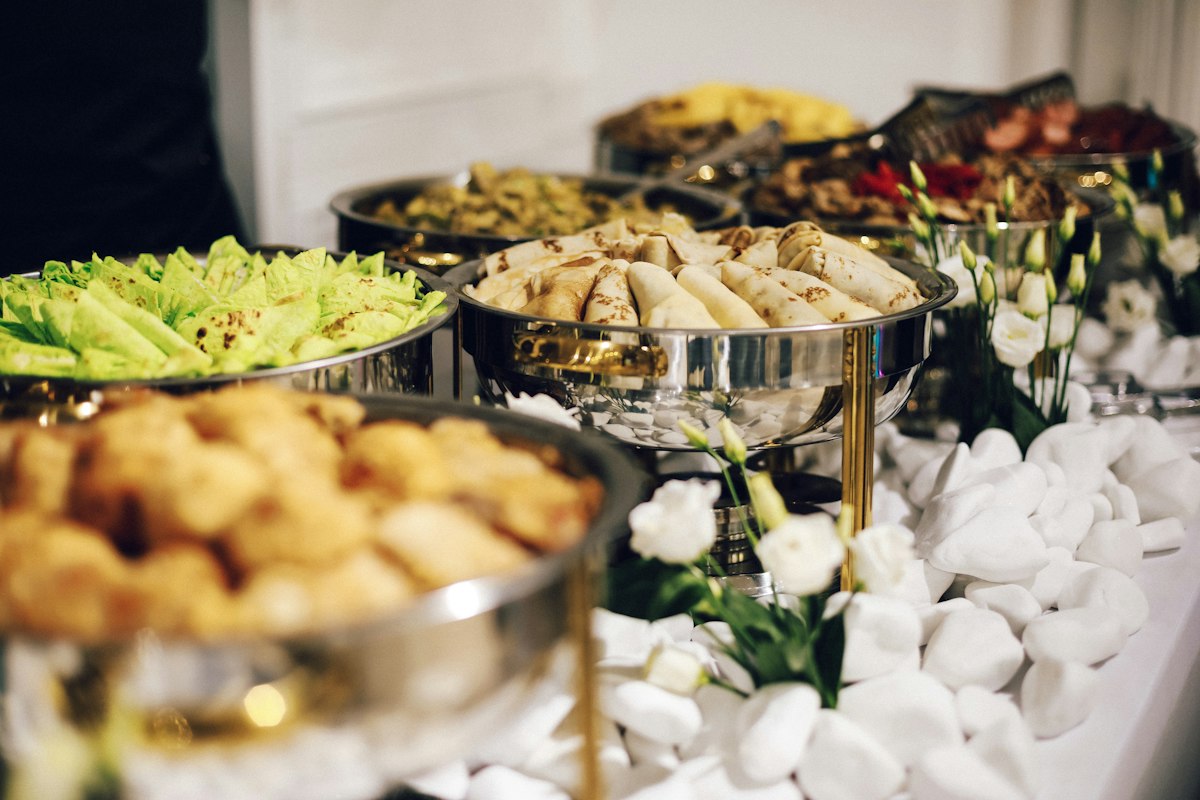
- Chafing dishes: For buffet-style service, chafing dishes with gel fuel or electric heating keep food at serving temperature. Budget £15-40 each; you'll need one per dish (typically 8-12 for a full menu).
- Gas burners: If the venue has no kitchen facilities, portable gas burners allow you to reheat and finish dishes on site. Ensure the venue allows naked flames.
- Cool boxes: For transporting cold items (raita, salads, desserts) separately from hot food.
The Logistics of Getting There
A catering order for 120 people generates a surprising volume of equipment and food. You'll typically need a van — a standard car won't cut it. Allow at least two hours for loading, transport, and setup before the serving time. Bring more napkins, serving utensils, and containers than you think you'll need. Something always gets forgotten; bring spares of everything.
Staffing
You can't run a 120-person catering event alone. As a general guide:
- Buffet service: 1 staff member per 30-40 guests for plate replenishment, plus 1-2 for drinks and clearing
- Plated service: 1 staff member per 15-20 guests for table service
- Kitchen/prep: At least 1 person on site to manage food temperatures, replenish dishes, and handle any cooking
Brief your team thoroughly beforehand. Everyone should know the menu, the dietary accommodations, the service format, and the timeline. Printed running orders are invaluable.
Pricing
Event catering pricing needs to cover not just food costs but transport, equipment hire (if not owned), staff time, preparation time, and a margin for the considerable risk and effort involved. Typical per-head pricing for curry catering in the UK:
- Buffet, 3-4 dishes + rice/naan: £15-22 per head
- Premium buffet, 5-6 dishes + starters + dessert: £22-30 per head
- Plated service, 3 courses: £28-45 per head
- Wedding catering, full service: £35-60+ per head
Always quote a minimum order value (typically £500-800 for events under 30 people) to ensure the job is economically viable after all costs. Our wedding catering guide covers the premium end of the market.
Insurance and Food Safety
Off-premise catering introduces additional liability that your standard restaurant insurance may not cover. Check with your insurer that your public liability policy extends to external venues. If it doesn't, event-specific catering insurance is available from providers like Hiscox and Simply Business, typically costing £50-150 per event.
Your food hygiene obligations apply fully to off-premise catering. This means temperature monitoring (take a probe thermometer and log readings), allergen information available for all dishes, and proper hand-washing facilities at the venue. If the venue doesn't have running water, bring portable hand-washing stations or antibacterial gel as a minimum.
Building Your Catering Reputation
The best marketing for event catering is word of mouth from delighted clients. Photograph every event (with permission), ask for testimonials, and create a dedicated catering page on your website with sample menus and pricing. Corporate events, birthday parties, and community celebrations generate repeat business and referrals at a rate that far exceeds restaurant dining. Once you've done three or four successful events, the enquiries start coming to you.
Related Articles
Wedding Catering with Indian Food: A Growing Trend
Indian wedding catering has gone mainstream in the UK. From intimate receptions to grand affairs, curry is the new wedding feast.
Eid Celebrations: Menu Ideas for Restaurants
Eid is one of the biggest dining-out occasions of the year. Special menu ideas to make the celebration memorable at your restaurant.

Organising a Charity Curry Night for Your Community
A charity curry night builds community goodwill and puts your restaurant in the spotlight. Here's how to organise a great one.